A Gentlemen's Motorcar
Automobiles from Wolseley Motors embodied quiet authority, prestige, and the enduring elegance of British engineering.
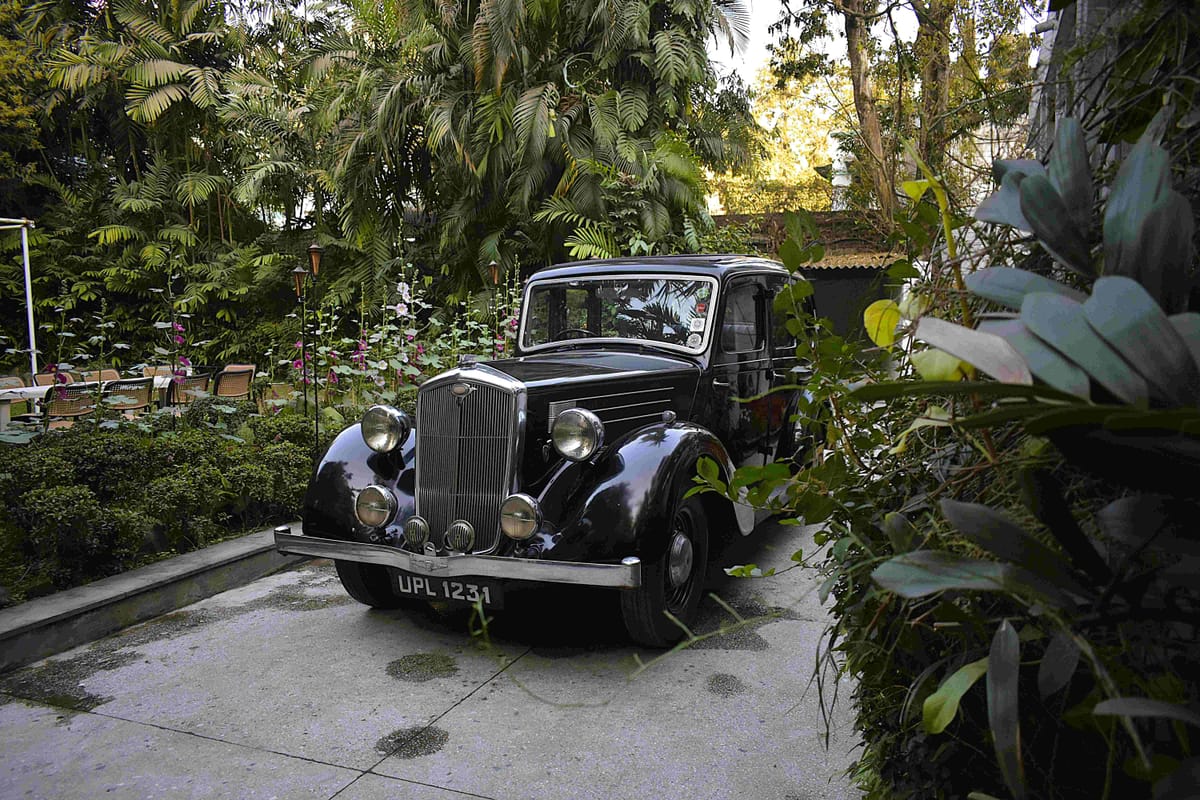
From Varanasi to Calcutta: The Story of the 1947 Wolseley 14/60 H.P. Saloon
Text & Images: Yatharth Seth
In the early decades of the twentieth century, British marques such as Wolseley Motors introduced their refined motorcars to India, where they quickly became favoured by administrators, legal luminaries, and affluent businessmen across cities such as Calcutta, Bombay, and Delhi. These automobiles represented far more than mere transportation; they embodied quiet authority, prestige, and the enduring elegance of British engineering.
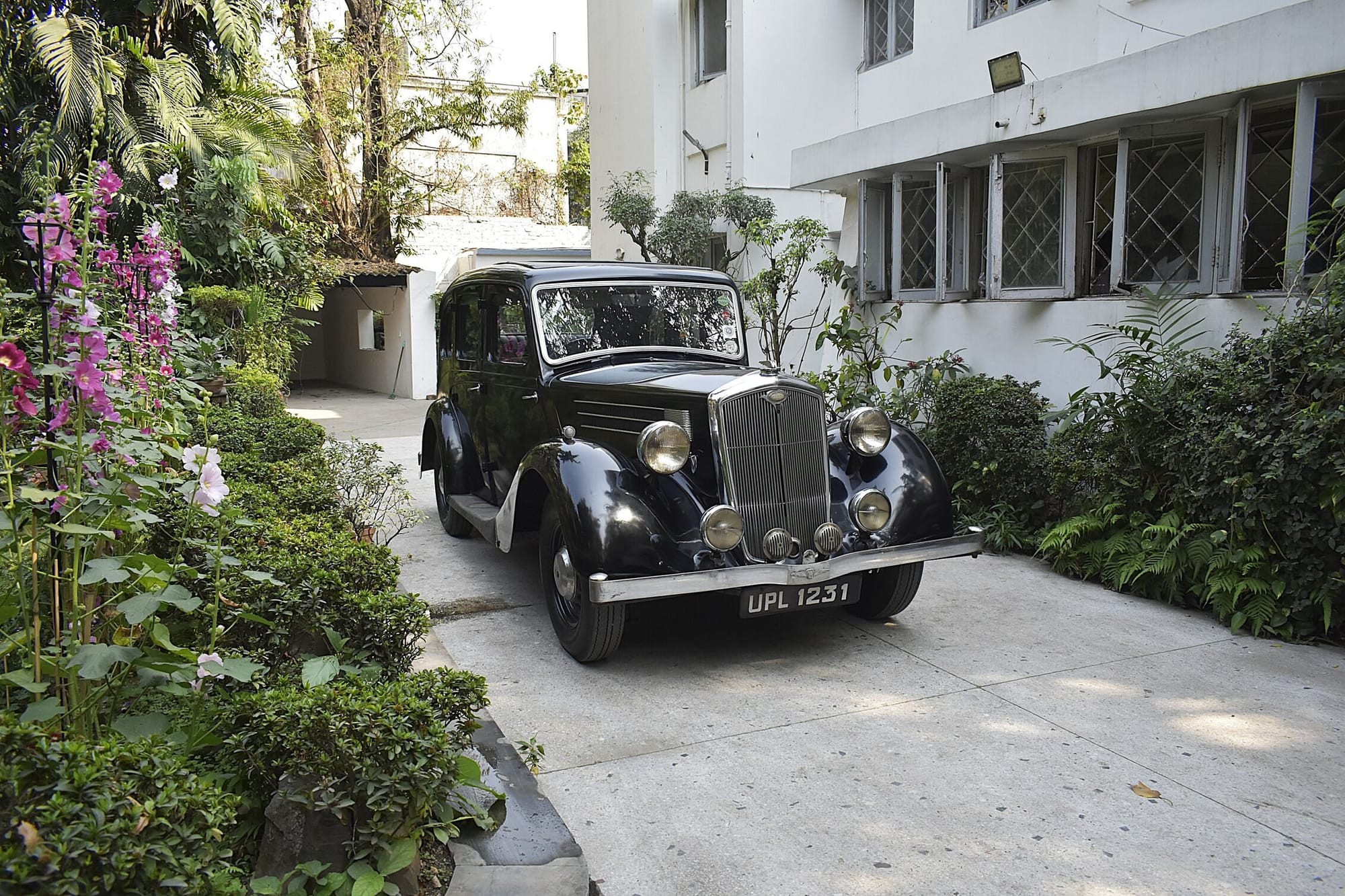
This is the story of one such surviving motorcar. Purchased in London in 1947 by Rai Bahadur Munnalal Govila, a prominent government counsel from Benares (now Varanasi), the dignified Wolseley formed part of a pair of automobiles he acquired during a visit to Britain. Travelling aboard the ocean liner SS Strathmore, Govila purchased both a 1947 Wolseley 14/60 H.P. Saloon and a 1947 Wolseley 8. Later that same year, the Wolseley 14/60 was shipped to his residence in Varanasi, while the Wolseley 8 made its way to Calcutta. Over the decades that followed, the Wolseley 14/60 remained a silent witness to changing times before eventually finding renewed life in Kolkata. The distinguished motorcar bearing the registration UPL 1231 stands today as a cherished heirloom and has been in the possession of Siddharth Swarup since 1993. Under his careful stewardship, the automobile has been preserved and celebrated, earning numerous accolades within Kolkata’s vintage and classic motoring community.
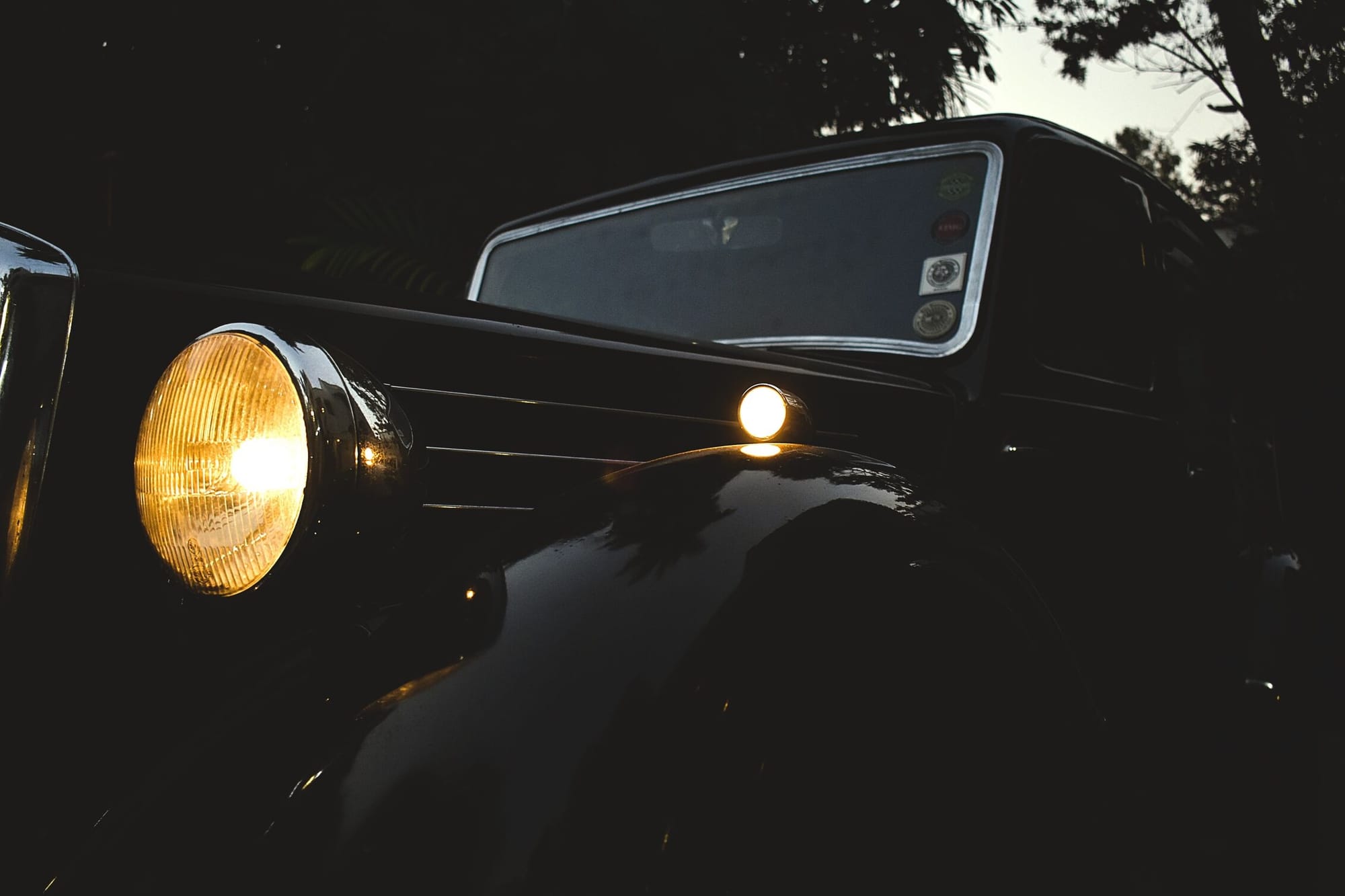
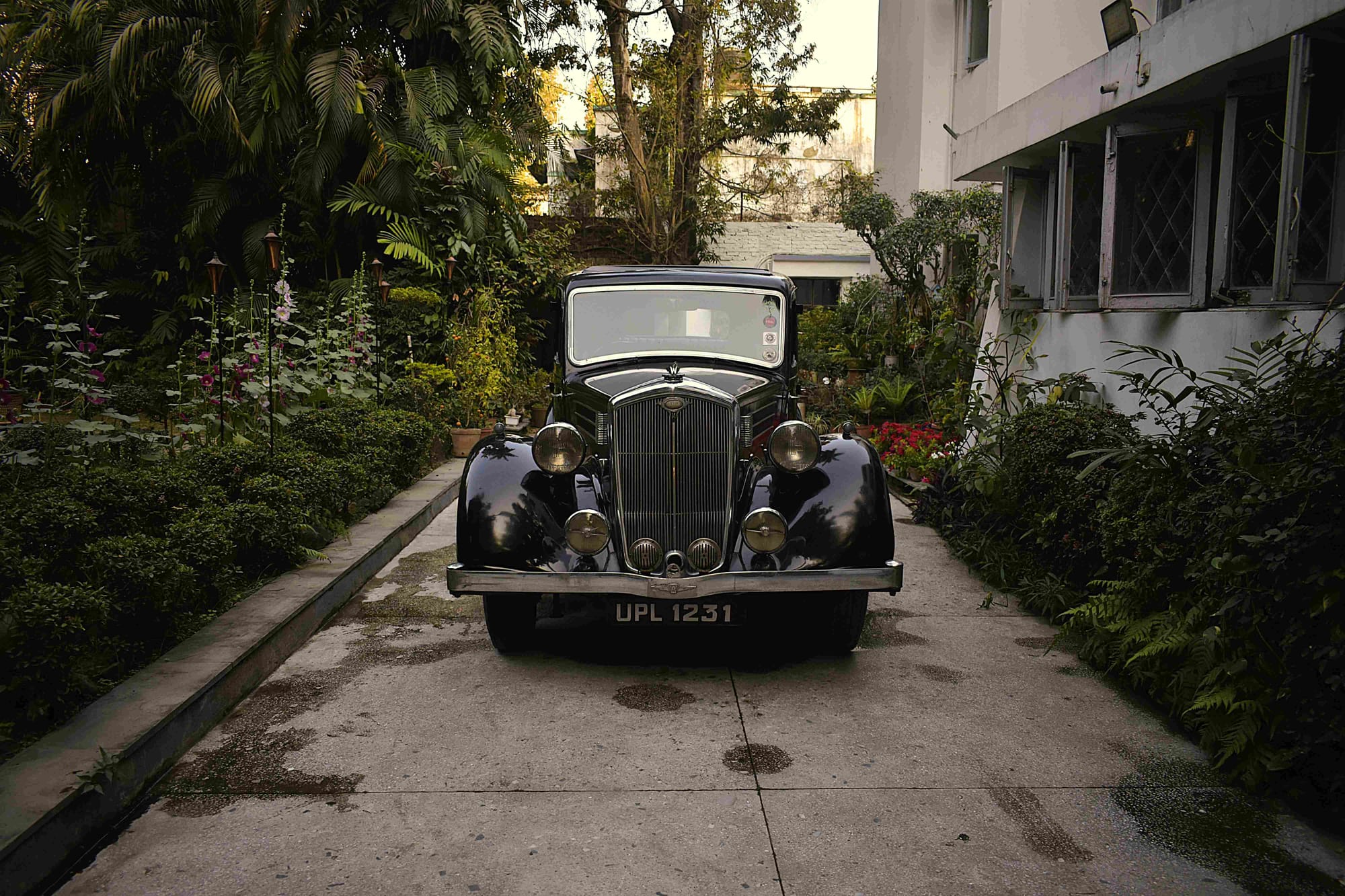
In 1991, when the family’s ancestral property in Varanasi was being sold, the car too was destined for sale. However, no buyers were willing to offer its true value. The Wolseley had been laid up for approximately two decades and was not in roadworthy condition. At this point, Siddharth’s father, Mr V. Swarup, asked whether he would like to take charge of the car and restore it. He readily accepted, and the automobile was brought to Calcutta on his birthday in March 1991. Within six months, it had been made roadworthy, and its first post-restoration journey took place in September 1991, on his father’s birthday, which was celebrated at the Taj Bengal in Calcutta.
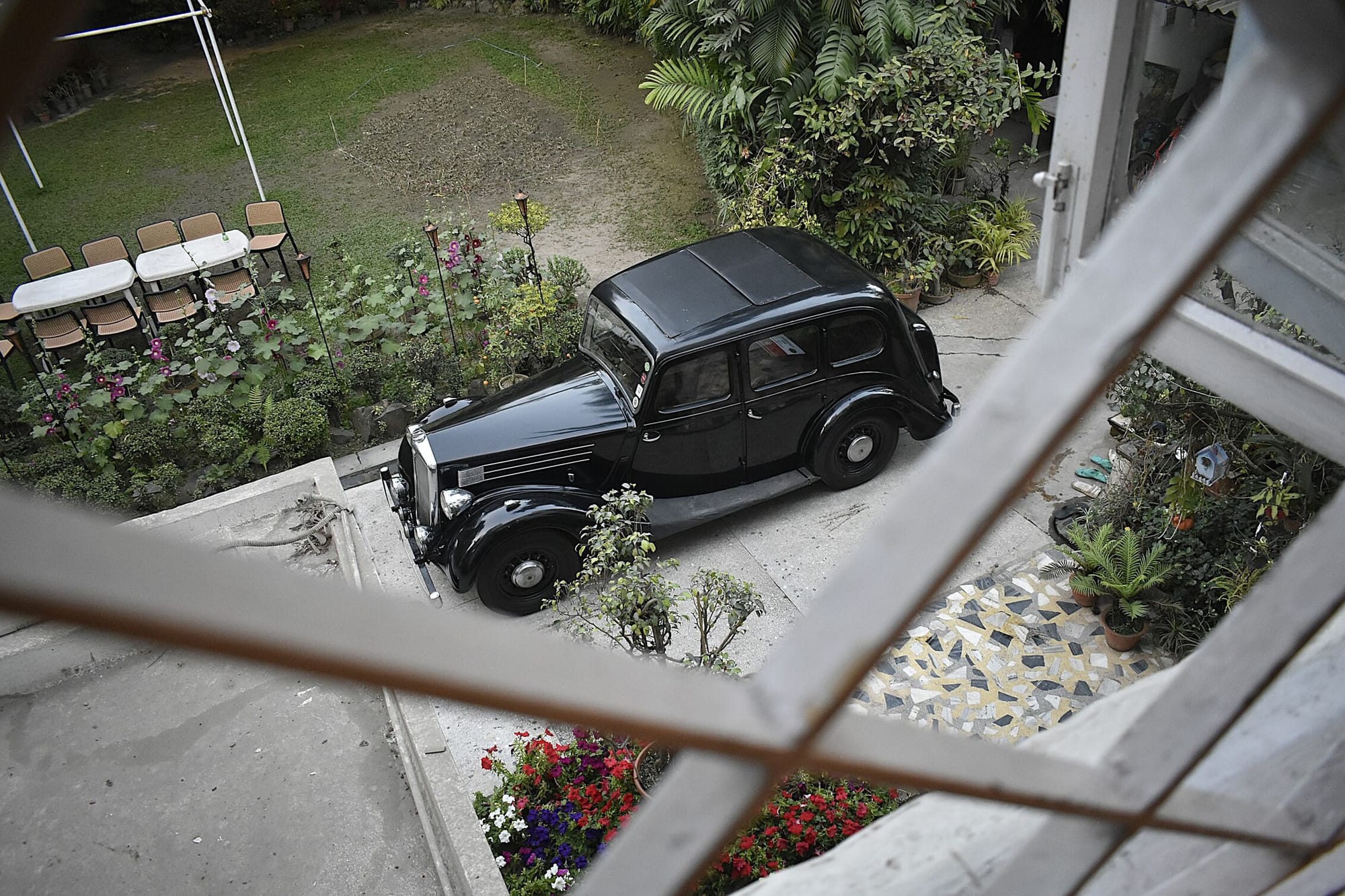
In February 2003, the Wolseley found cinematic recognition when noted film director Shyam Benegal used it in his film Netaji: The Last Hero (released 13 May 2005), based on Netaji Subhas Chandra Bose. The car appeared in shooting sequences at various locations and studios in and around Calcutta. Wolseley had always maintained a quiet yet dignified presence in India, particularly during the late colonial period and the early years after Independence. The marque appealed to civil servants, princely states, legal professionals, and affluent businessmen alike. Siddharth’s Wolseley 14/60 is among the few surviving examples in pristine condition, from an estimated 25–50 automobiles imported into India between 1945 and 1948. Today, approximately 5–10 examples are believed to survive out of roughly 125 Wolseleys imported between 1938–39 and 1945–48.
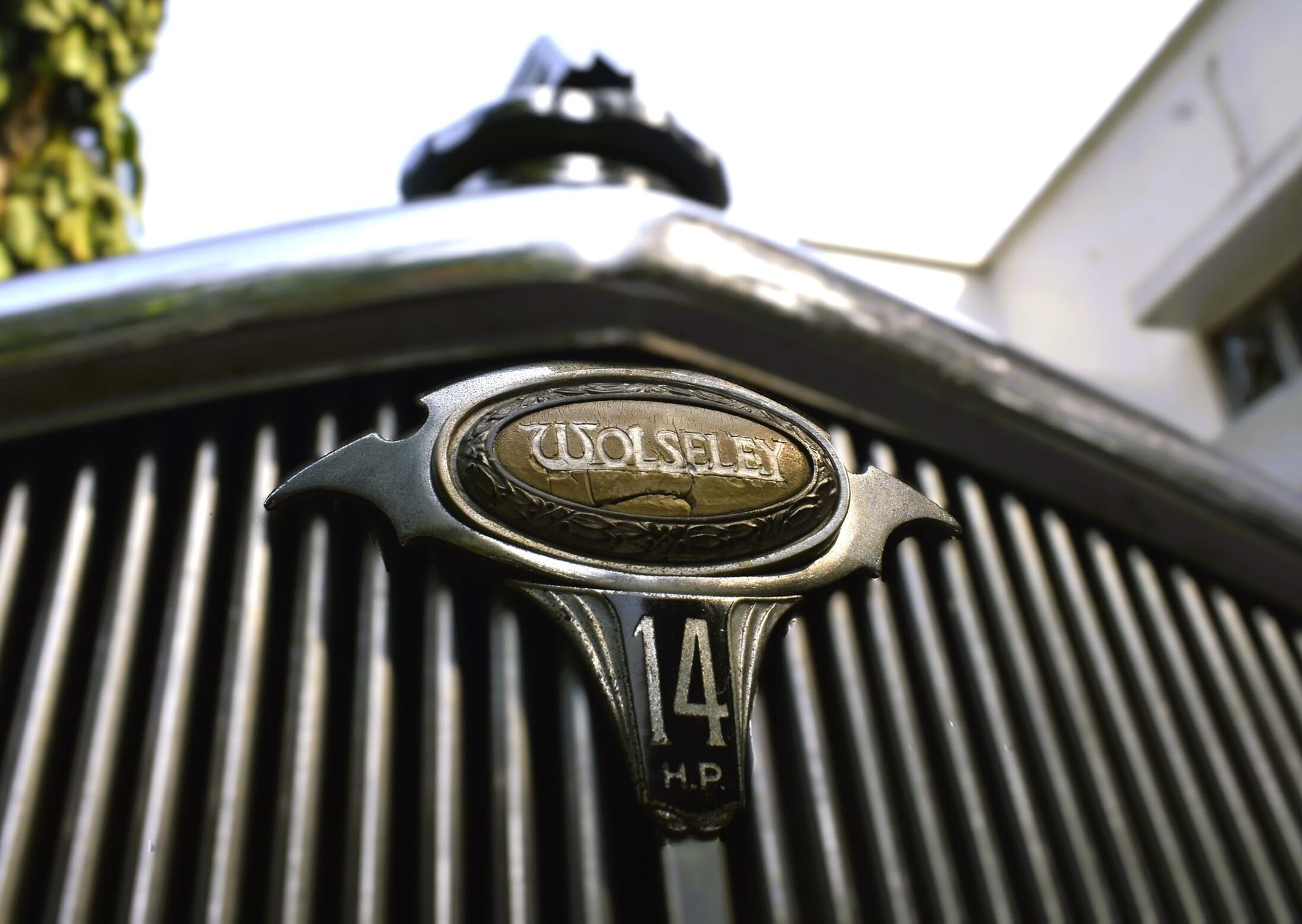
This image offers a close-up of the radiator badge adorning the Wolseley 14/60, a proud creation of Wolseley Motors, presented to Siddharth Swarup as a gift at the 1993 Statesman VCCR in Calcutta. Set against finely spaced vertical chrome slats, the oval Wolseley emblem takes centre stage, its engraved lettering framed by subtle decorative flourishes that reflect the marque’s heritage. Beneath the crest rests the “14 H.P.” insignia, denoting the car’s class within the Wolseley range. The badge, with its aged enamel and softened metallic sheen, bears the dignified patina of time.
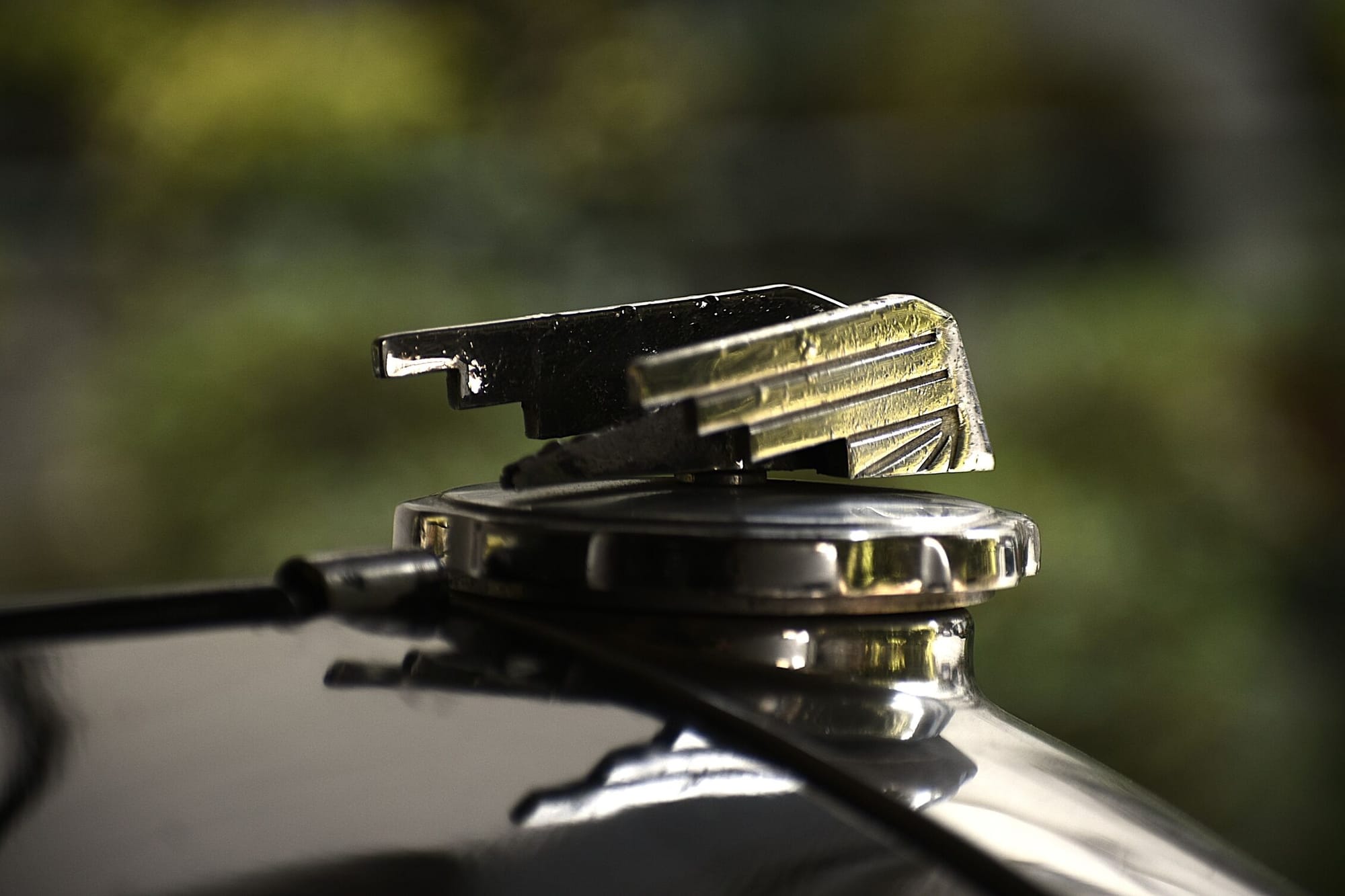
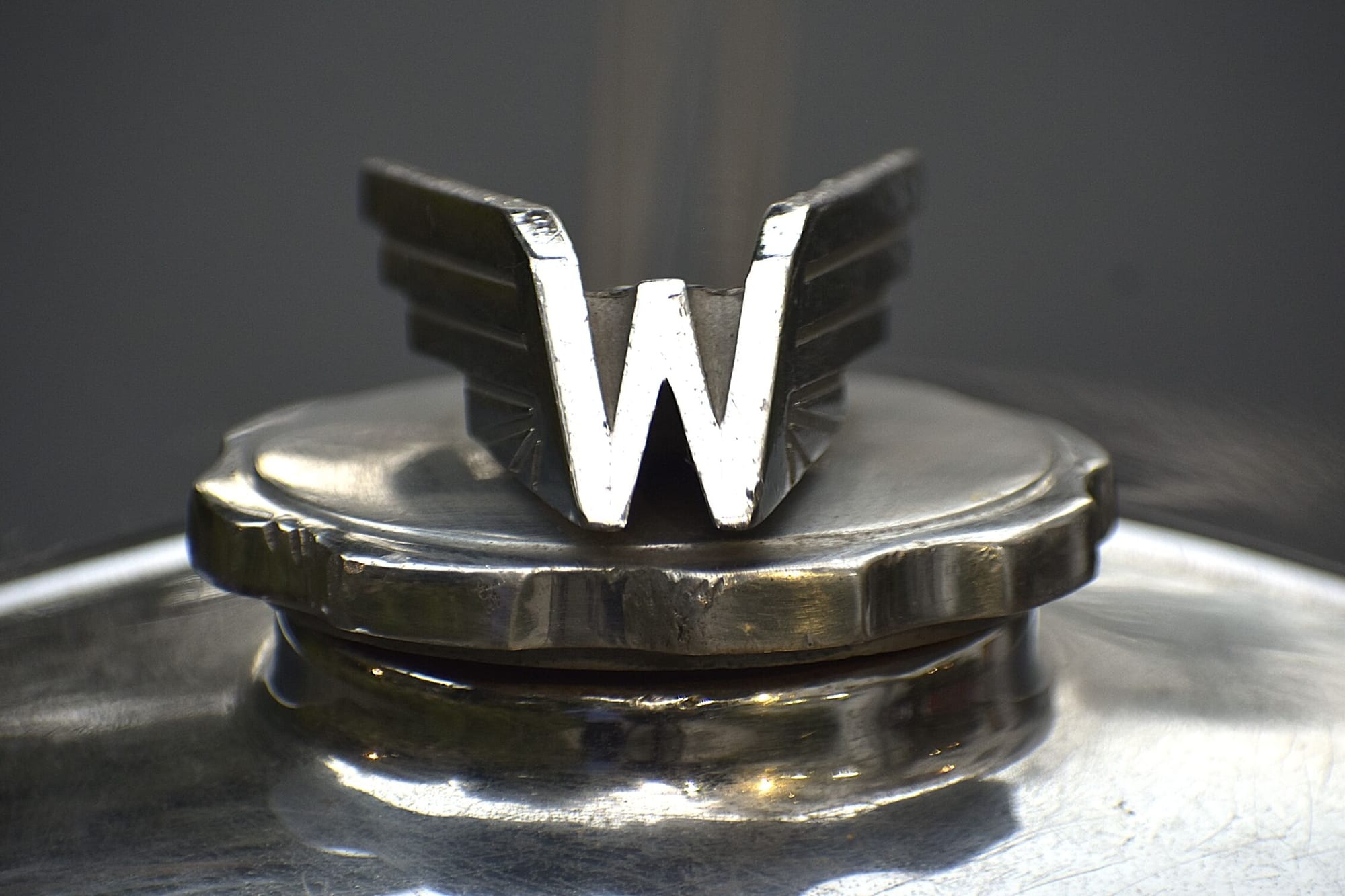
The Flying W (left); Heading towards the hood ornament (right)
The “Flying W” hood ornament on Wolseley cars was introduced around the mid-1930s as part of the company’s effort to strengthen its luxury identity. Although the individual designer is not recorded, it was developed in-house as part of Wolseley’s evolving styling. The ornament featured a stylised winged ‘W’, symbolising speed and refinement, mounted atop the radiator. Another distinctive feature was the illuminated badge, which glowed when the vehicle’s lights were switched on, combining visual elegance with practical night-time visibility.
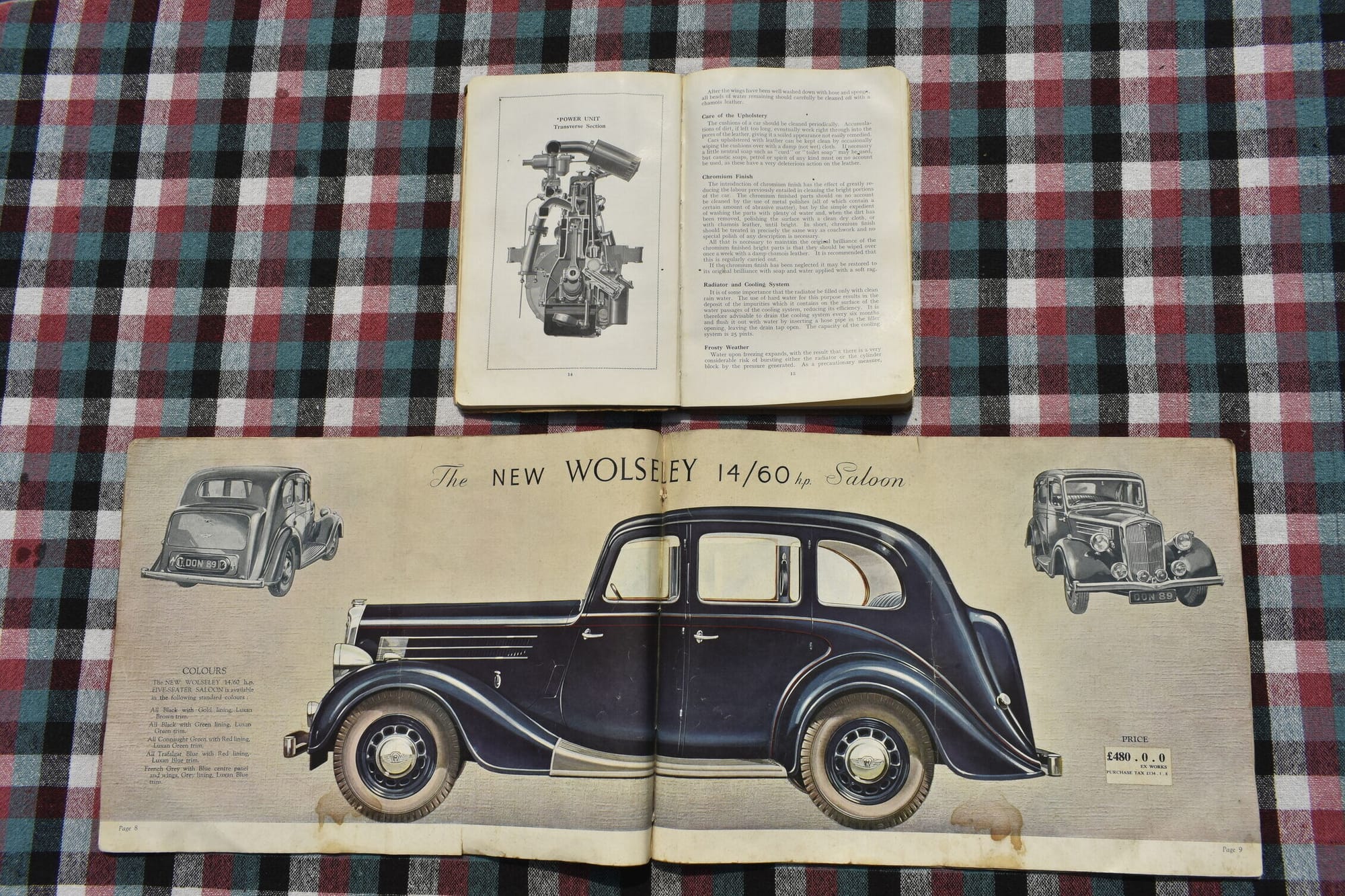
The image showcases an original owner’s manual and sales brochure for the Wolseley 14/60. The manual reveals detailed mechanical diagrams and period technical guidance, reflecting the engineering precision of the era. Beneath it, a beautifully illustrated brochure presents the stately saloon in refined detail, complete with period typography and original pricing. The gentle patina of the pages evokes the elegance of late-1940s motoring.
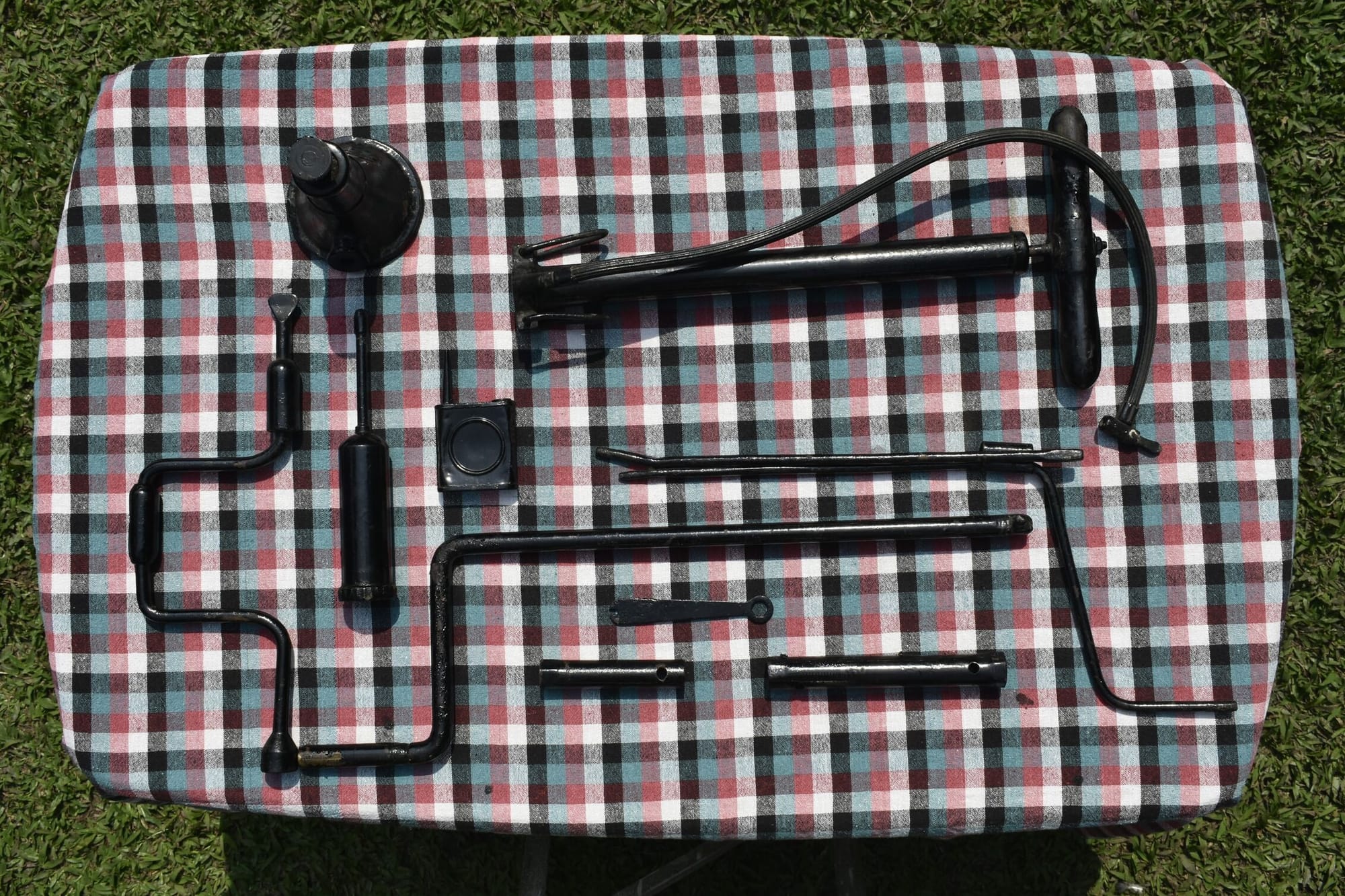
The original toolkit of the 1947 Wolseley 14/60 H.P. Saloon reflected the marque’s commitment to self-reliant motoring. Finished in blackened steel, the set comprised a starting handle, box spanners with tommy bars, open-ended spanners for Whitworth fittings, a tyre pump with flexible hose, a grease gun, screwdrivers, tyre levers, and a Shelley jack. Each piece was engineered for durability and neatly stowed within the vehicle.
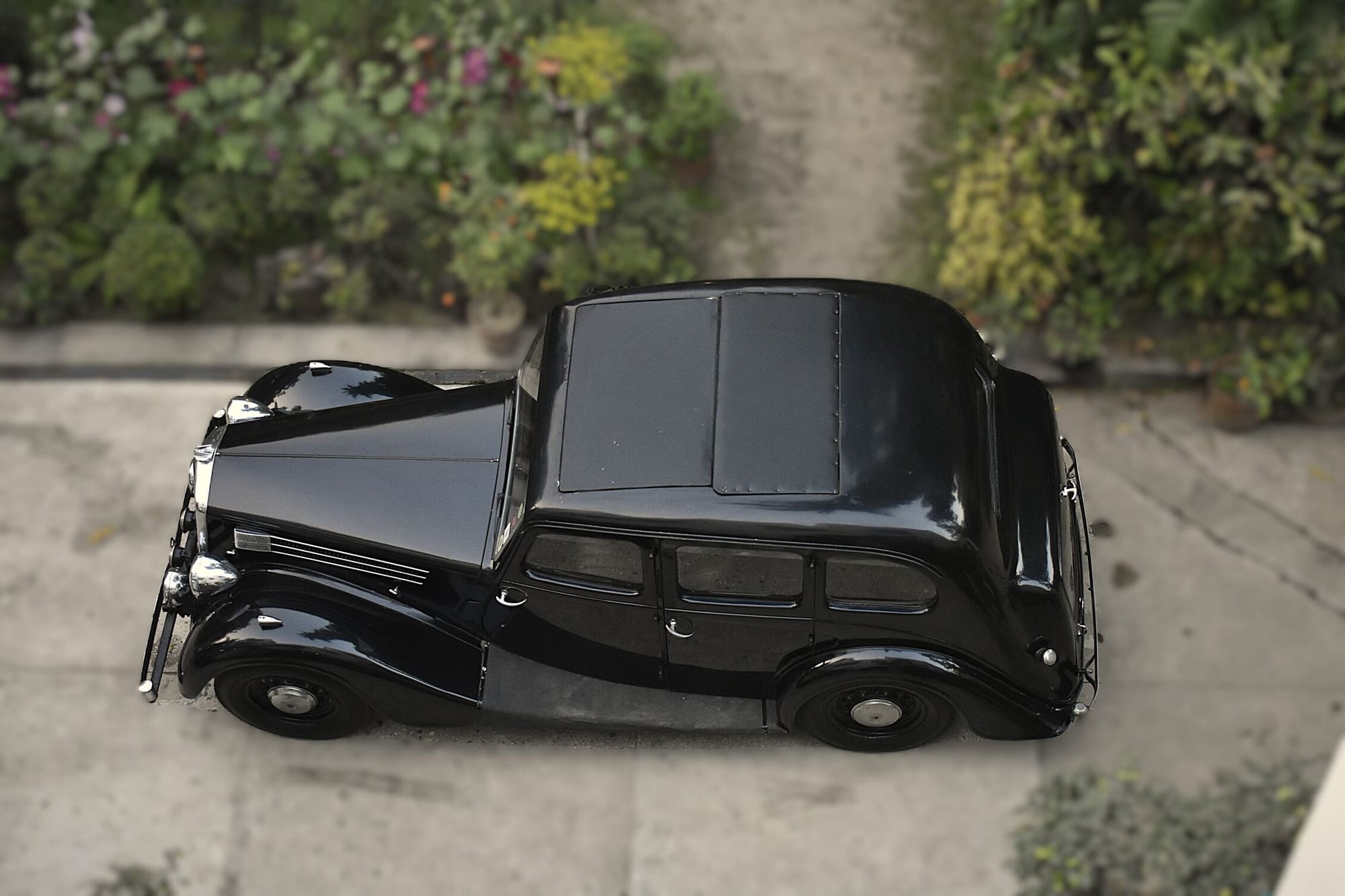
The Wolseley has remained a single-family motorcar since purchase, a factor that has contributed to its remarkable preservation. Since the early 1990s, it has earned numerous awards within Calcutta’s vintage and classic car circles, including the INTACH Award, Preservation Class Trophy, and the Statesman Trophy.
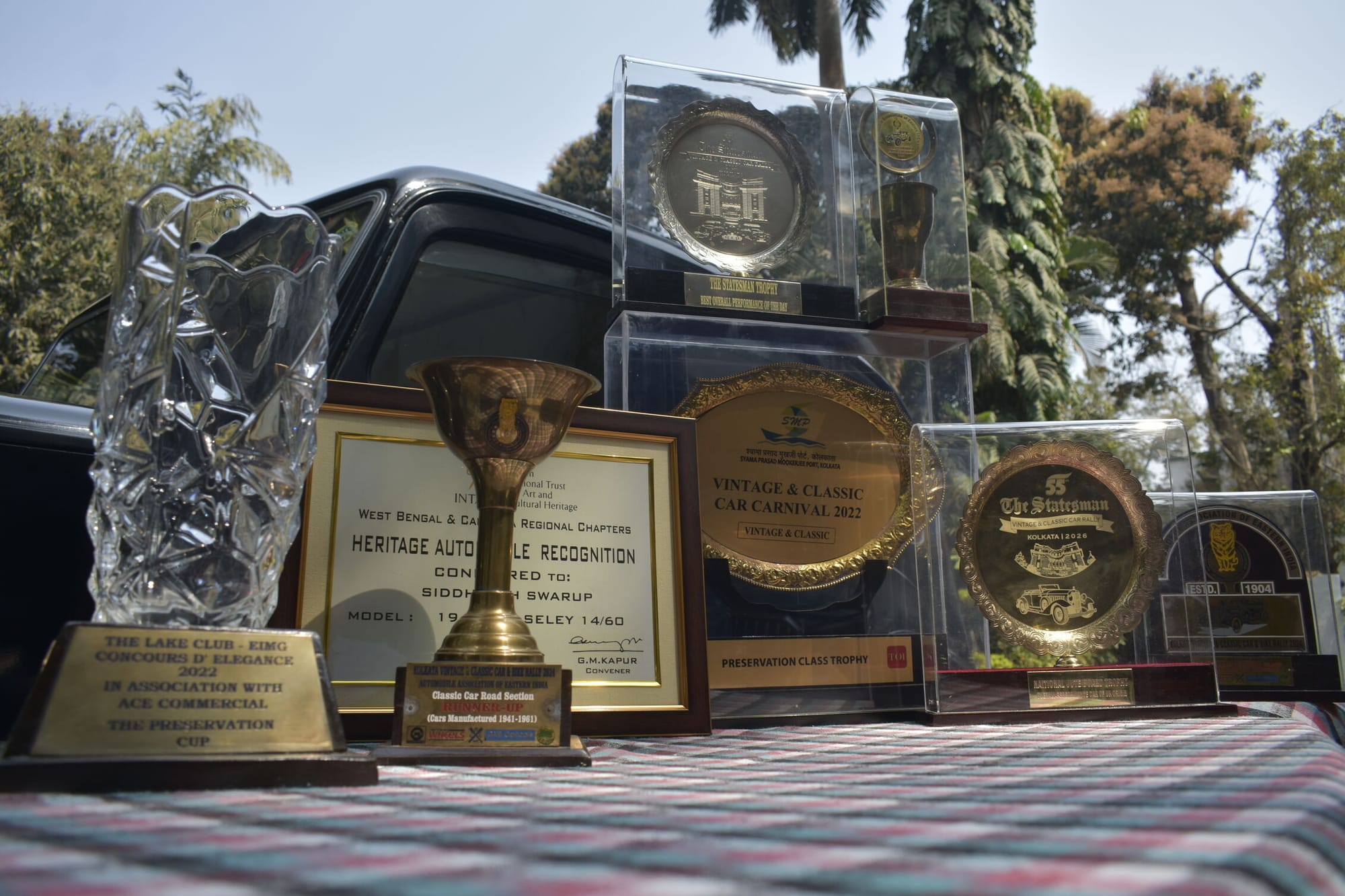
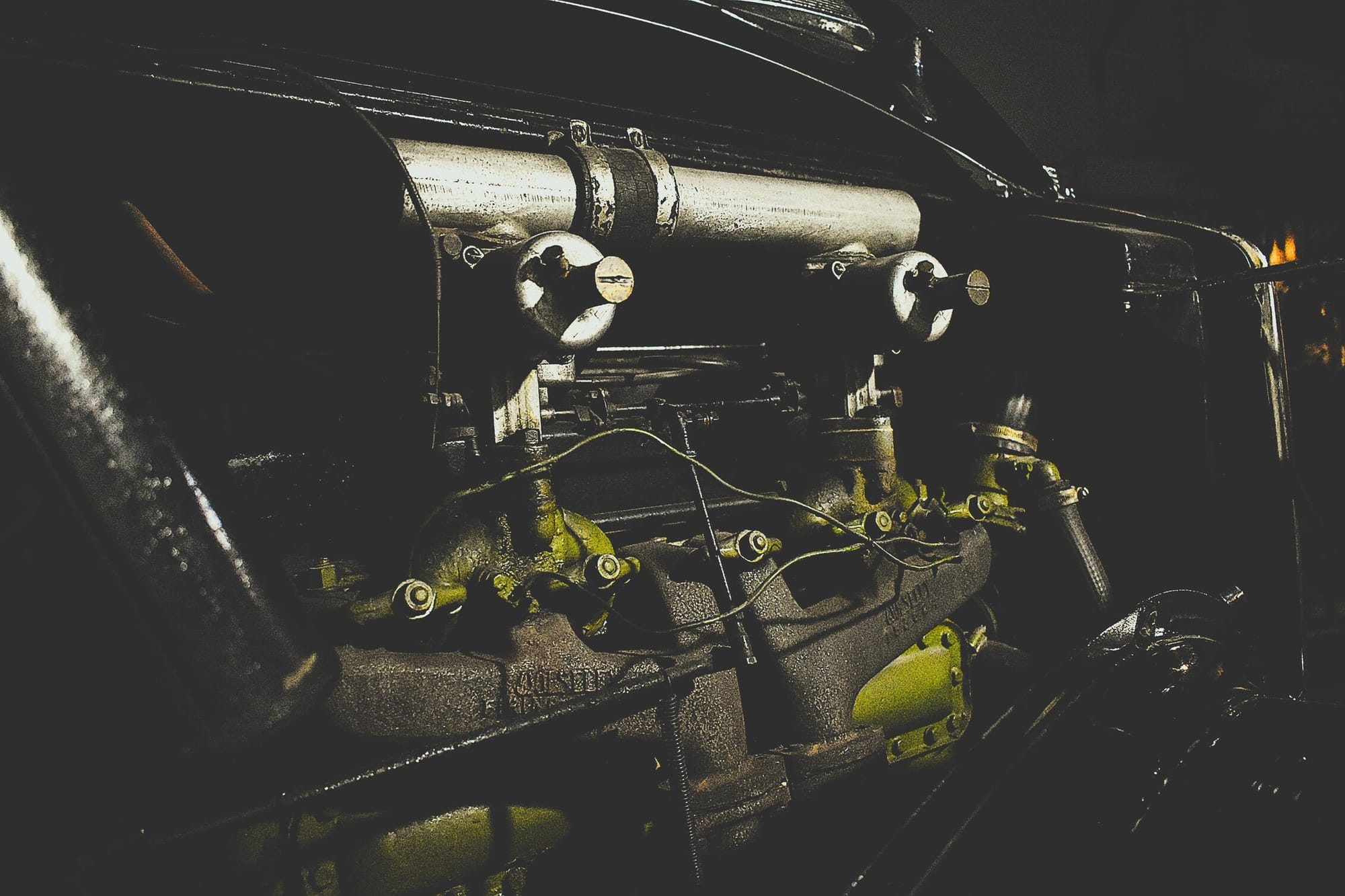
A close-up of the recognitions (left); the engine (right)
Beneath the dignified presence of the Wolseley 14/60 lies a 1.8-litre six-cylinder engine producing approximately 60 bhp. Known for its smoothness and reliability, it features twin SU carburettors and full-pressure lubrication. A four-speed manual gearbox with synchromesh on upper ratios ensures relaxed progress, while hydraulic brakes provide confident stopping power.
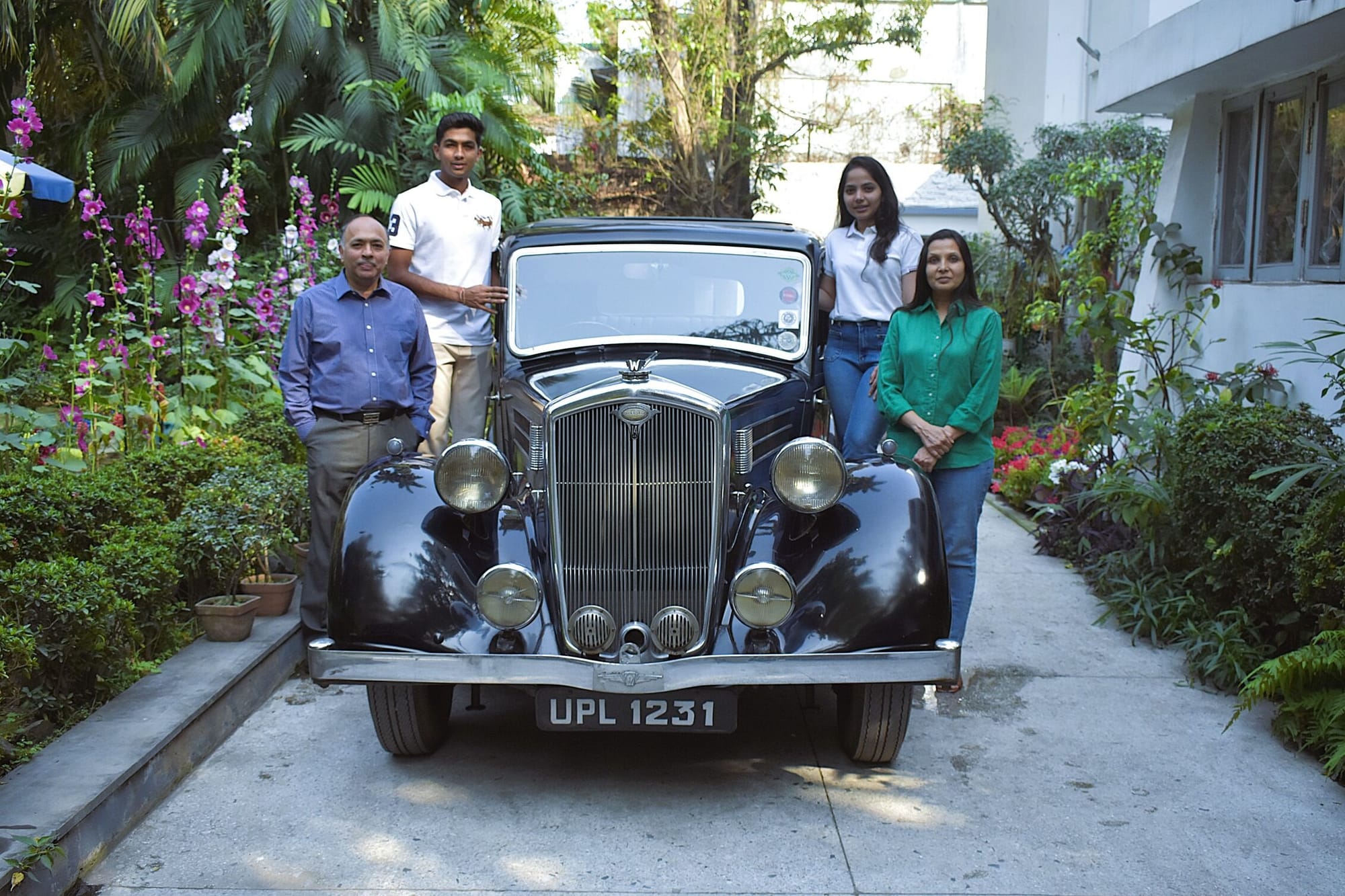
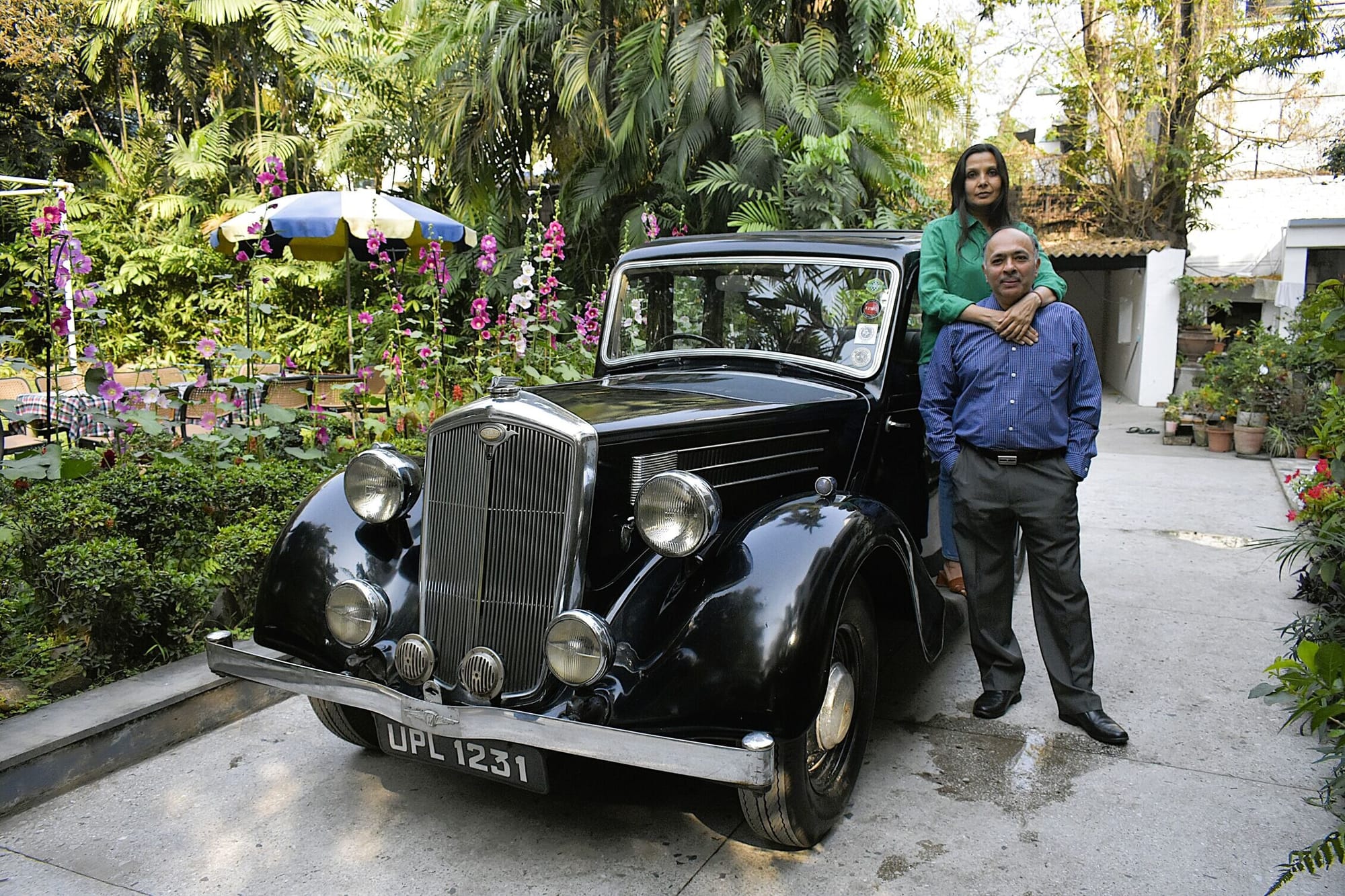
The Swarup family (left); Mr. and Mrs. Swarup (right)
The story of this Wolseley bearing the number plate UPL 1231 is not merely that of an automobile, but of continuity and preservation. From its quiet repose in Varanasi to its careful restoration in Calcutta, the motorcar reflects post-war British craftsmanship. Under Siddharth Swarup’s stewardship, it has evolved from conveyance to heritage artefact, earning recognition and admiration among enthusiasts.
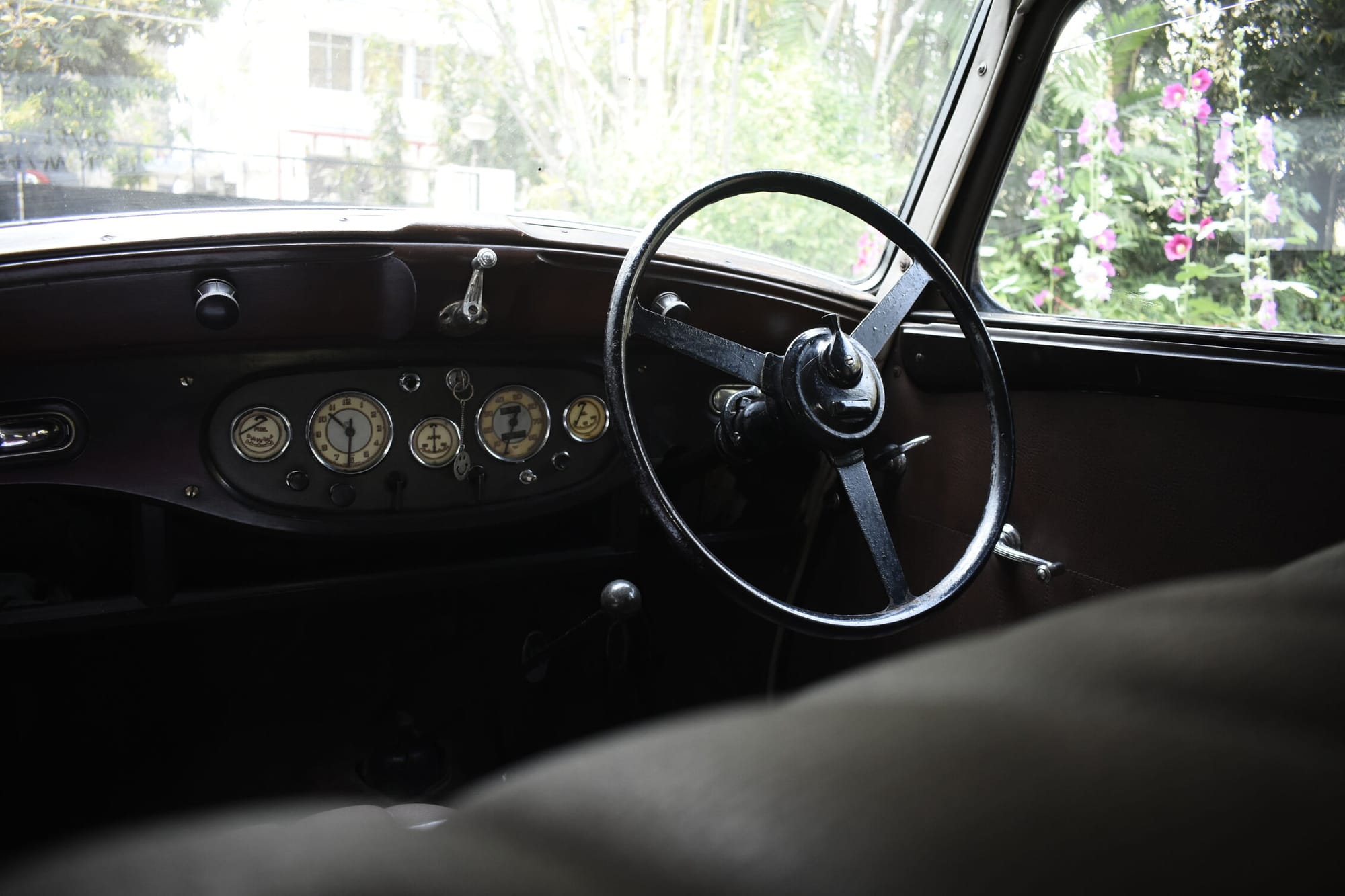
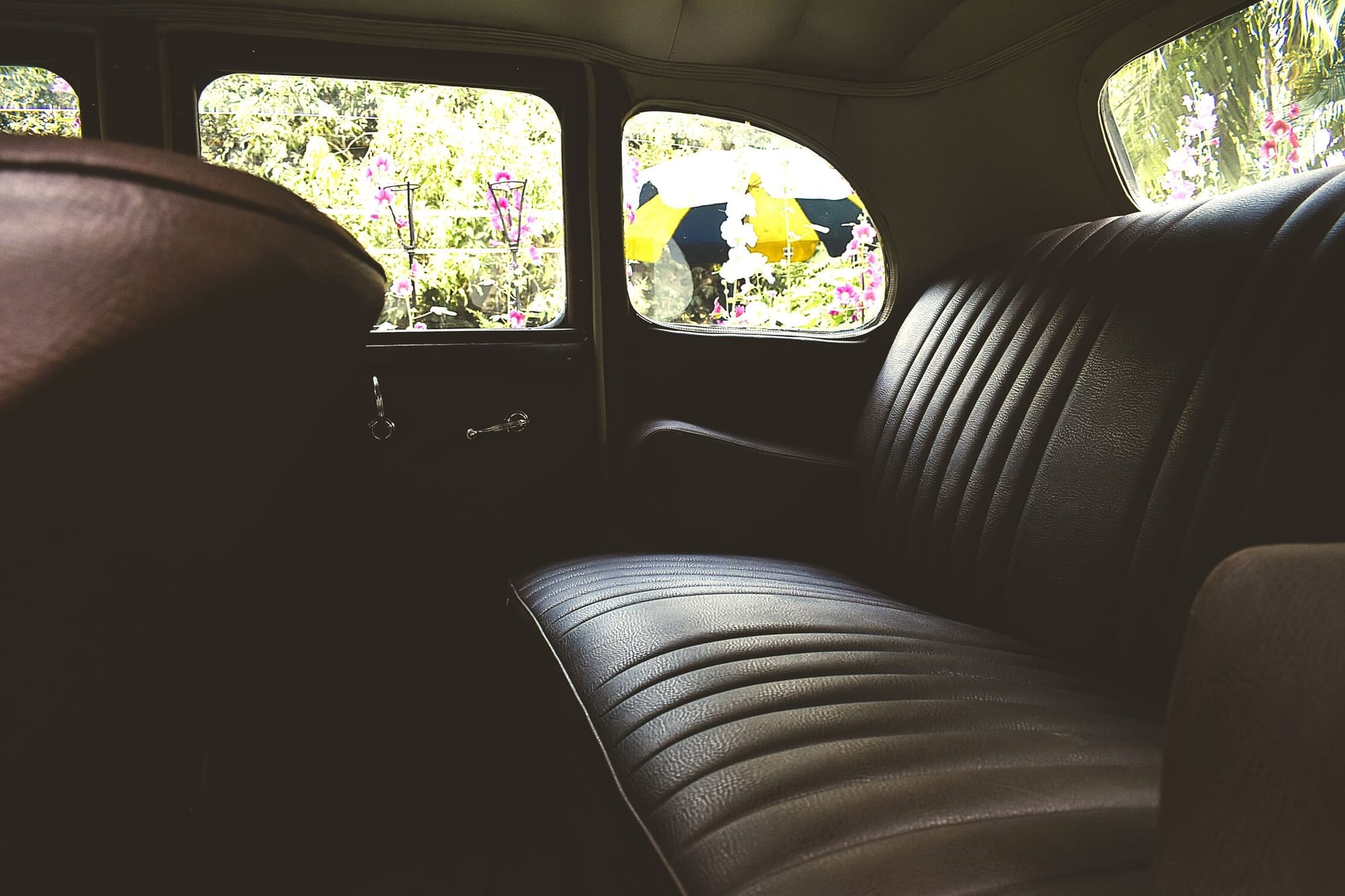
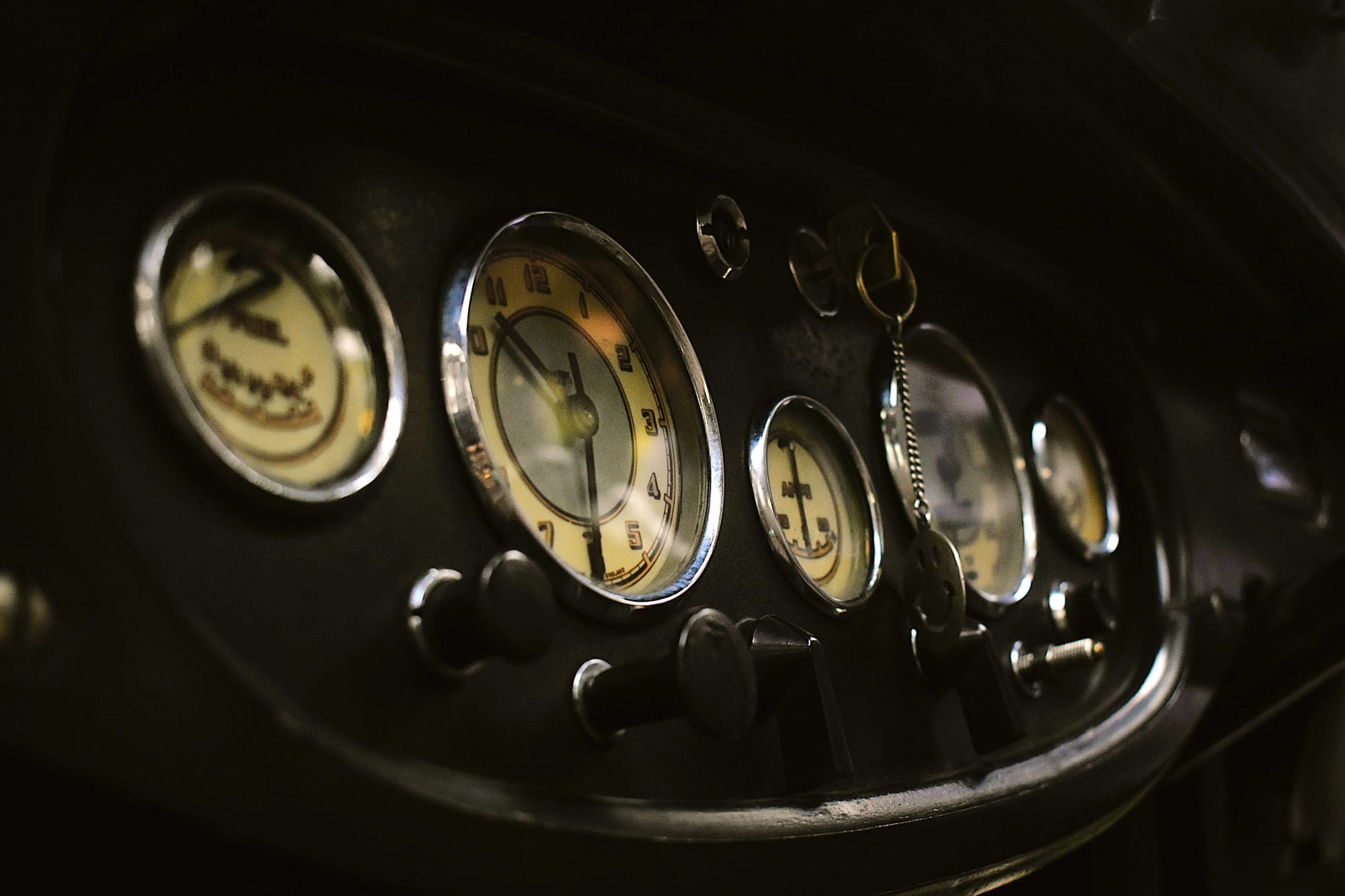
Interior showcasing the front seats, dashboard and the adjustable steering wheel (left and centre); A close-up of the instruments (right)
The interior reflects understated luxury typical of post-war British motoring. A polished wooden dashboard houses analogue gauges, while generously cushioned seats provide comfort for long journeys. Chrome accents and a large steering wheel enhance the period atmosphere, and the quiet cabin contributes to the dignified motoring experience
Comments ()